CFD · Phase change
My contribution
I implemented coupled phase-field, flow, and heat-transfer solvers and developed a dedicated 1D Stefan benchmark solver.
Research implementation · validation limitations documented
0.079% interface-position error in the dedicated 1D Stefan test; physical 3D validation is pending.
Problem
Modelling the coupled interface, flow, and heat-transfer physics of boiling (vapour-liquid phase change under turbulent flow) with a PDE formulation that stays numerically tractable and portable to 3D.
Approach
A conservative Allen-Cahn phase-field model is coupled with incompressible Navier-Stokes and an energy equation containing a latent-heat source term, following Roccon (2025). The resulting pressure Poisson equation has constant coefficients and is solved directly with FFTs, a property that holds in 3D and is the main motivation for choosing this method.
Mathematical model
- Conservative Allen-Cahn interface
- Incompressible Navier-Stokes
- Energy equation with latent-heat source
Numerical method
- FFT-based pressure Poisson solver
- Conservative finite-difference discretisation
- 2D solver, dedicated non-periodic 1D Stefan solver, 3D solver
Verification
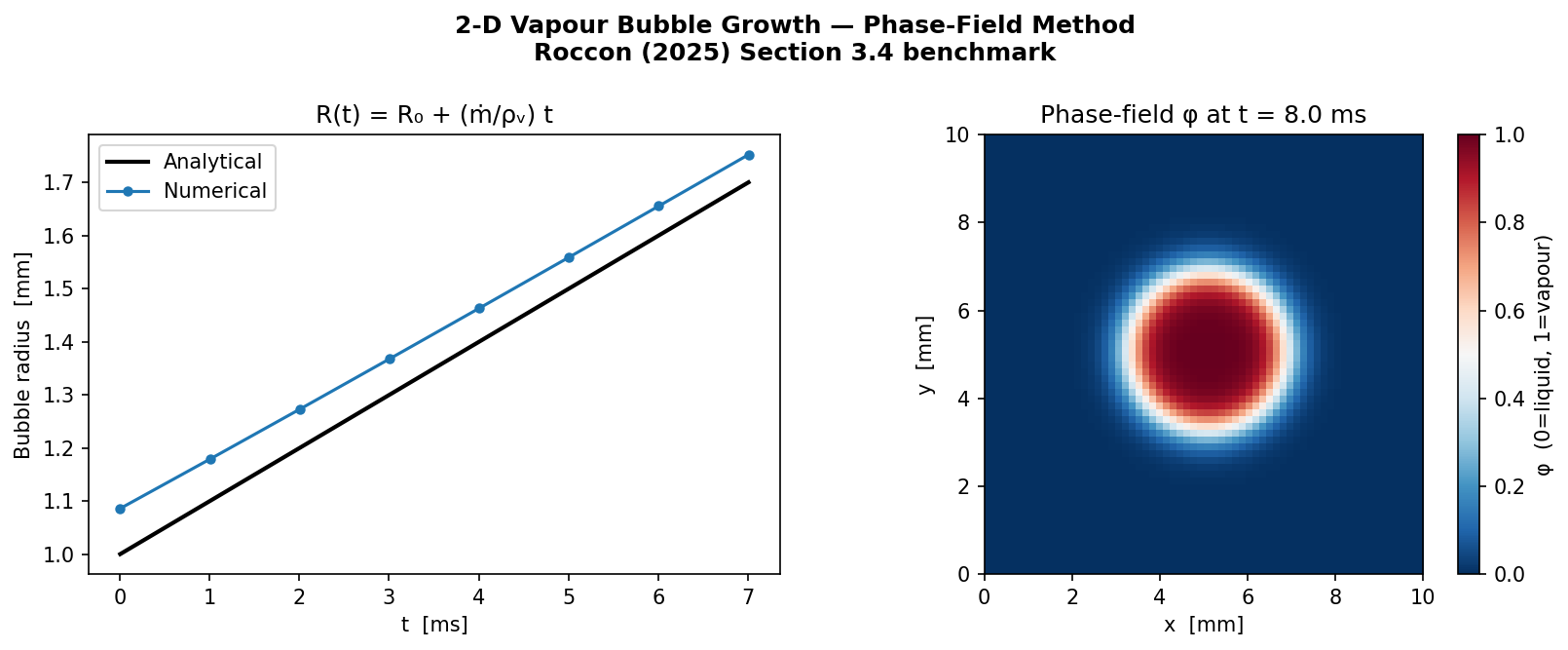
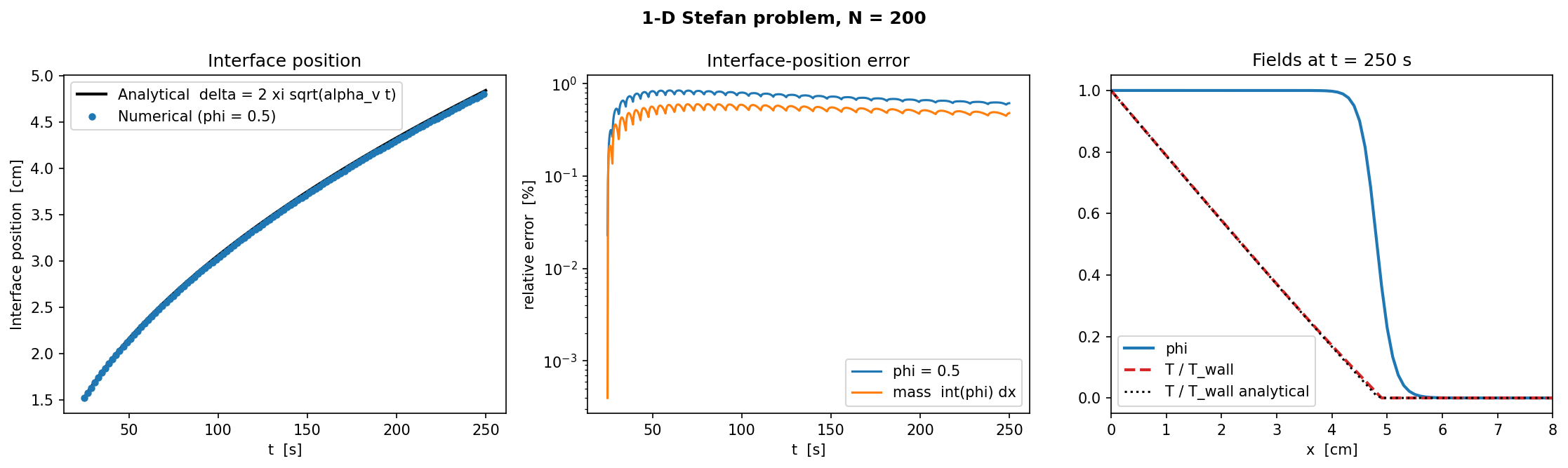
Two analytical benchmarks from Roccon (2025) were used. The bubble-growth benchmark (prescribed vaporisation rate) agrees with the analytical growth rate, and its error decreases systematically under grid refinement. The 1D Stefan problem exposed defects in the original benchmark implementation; after diagnosing them, a dedicated non-periodic 1D Stefan solver was developed. For the matched-density benchmark it reproduces the analytical solution with first-order convergence in grid spacing, reducing the interface-position error from 1.142% to 0.079% over Δx = 2.0 to 0.125 mm at t = 250 s, with discrete mass and energy balances verified. The 3D implementation is numerically verified (Poisson and projection convergence, phase-mass conservation, and consistency with the 2D solver on extruded problems, which also exposed and corrected a missing variable-viscosity term in the 3D operator); it is not physically validated.
Completed
- 2D bubble-growth benchmark: agreement with the analytical growth rate, error decreasing under grid refinement
- Dedicated 1D Stefan solver: first-order convergence, 0.079% interface-position error at Δx = 0.125 mm (t = 250 s, matched densities)
- Mass and energy balance diagnostics verified for the dedicated solver
- Allen-Cahn mobility scaling checked against the boundedness criterion of Mirjalili, Ivey & Mani (2020)
- 3D solver numerically verified (Poisson/projection convergence, phase-mass identity, 2D/3D consistency)
Ongoing
- Analytical benchmark for the general multiphase heat-flux pathway
- Physical 3D boiling benchmark
- Bubble-growth convergence-rate re-evaluation
Limitations
The dedicated 1D Stefan solver reproduces the analytical reference for matched densities only. The general multiphase heat-flux pathway does not yet reproduce its analytical benchmark. The 3D solver has no physical boiling validation yet. No convergence order is claimed for the bubble-growth benchmark, because a previously reported second-order rate is not currently reproduced.