My work connects numerical simulation, inverse problems, and scientific machine learning. I use analytical references, convergence studies, and controlled comparisons to understand both accuracy and limitations.
Reduced-order modelling & scientific ML
When does a fast approximation remain useful beyond the data or trajectories used to build it?
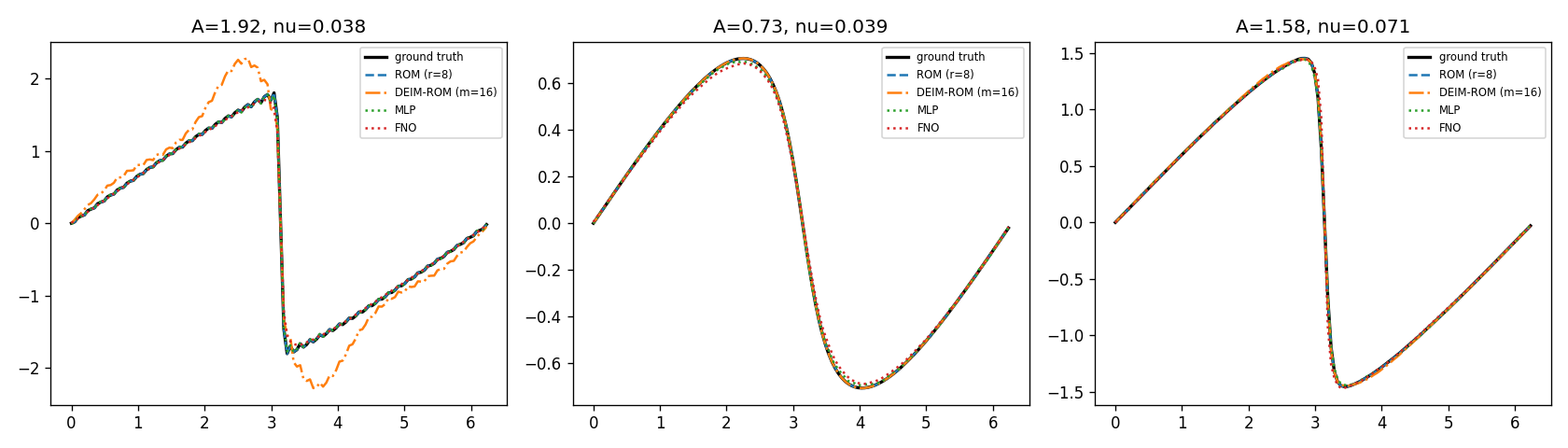
I compare POD-Galerkin models, DEIM hyper-reduction, neural operators, and physics-informed networks. For Burgers’ equation, four reduced or learned approximations are evaluated against a full-order solver, including tests on an unseen initial-condition family.
My focus is the relationship between accuracy, computational cost, and generalisation. This includes negative findings: a flow-specific POD basis can fail on unseen realisations, and stronger boundary constraints in a PINN need not improve global solution accuracy.
Inverse problems, optimisation & uncertainty
What can sparse or noisy observations tell us about a physical system, and how reliable are the resulting estimates?
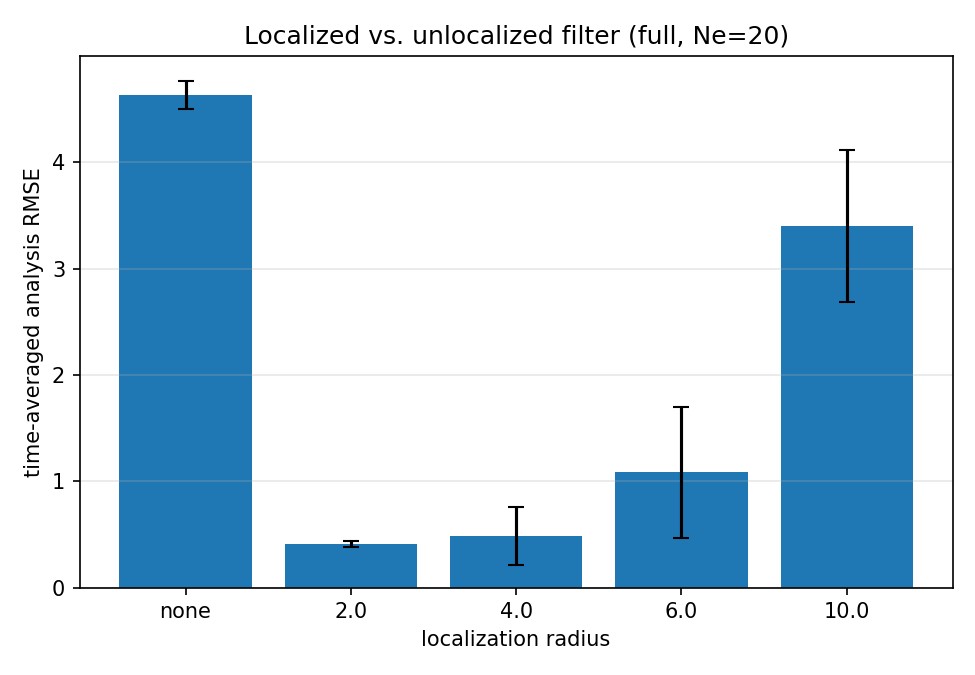
I work with adjoint-based PDE-constrained optimisation, regularisation, Bayesian inversion, and ensemble data assimilation. My implementations combine forward-solver checks with gradient tests or independent statistical reference problems.
My Lorenz-96 experiments investigate ensemble under-dispersion and localisation; my Darcy study examines regularisation mismatch and posterior mixing. These studies distinguish a good point estimate from a well-characterised uncertainty distribution.
Numerical PDEs & fluid dynamics
How can we establish the accuracy of a numerical model before using it to study physical behaviour?
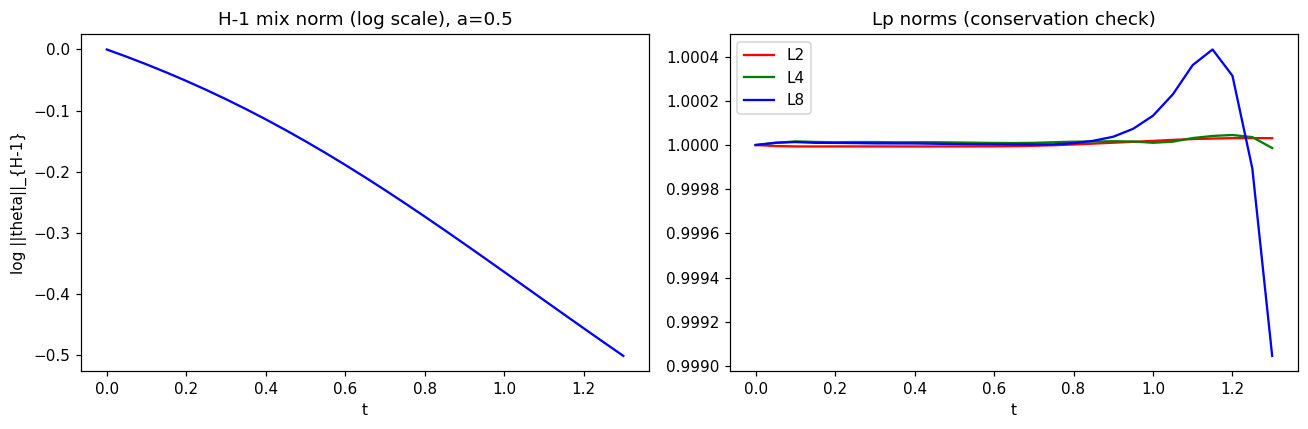
I develop spectral and finite-element solvers for incompressible flow, transport, elasticity, and phase change. Exact and manufactured solutions establish convergence; published benchmarks then test behaviour in more demanding settings.
Current questions include the effects of geometry and force evaluation on cylinder-wake benchmarks, the generalisation of reduced flow models, and physical validation of three-dimensional multiphase flow.
Related imaging & engineering work
My supporting work covers differentiable material optimisation, neural rendering, and volumetric segmentation. In industry, I have developed classifiers and data services for aviation telemetry; my independent engineering work includes an audio-based engine-monitoring prototype.
Future directions
I am interested in probabilistic and uncertainty-aware methods for learned PDE surrogates, reduced-order and inverse models, and data-efficient learning where observations are sparse, expensive, or physically constrained.
Discuss research opportunities →