Scientific ML · Numerical PDEs
My contribution
I implemented a PINN and ran a five-seed study of value-only versus value-and-derivative periodic boundary losses.
Research implementation
Derivative mismatch fell 7–38×; global solution accuracy did not improve reliably.
Problem
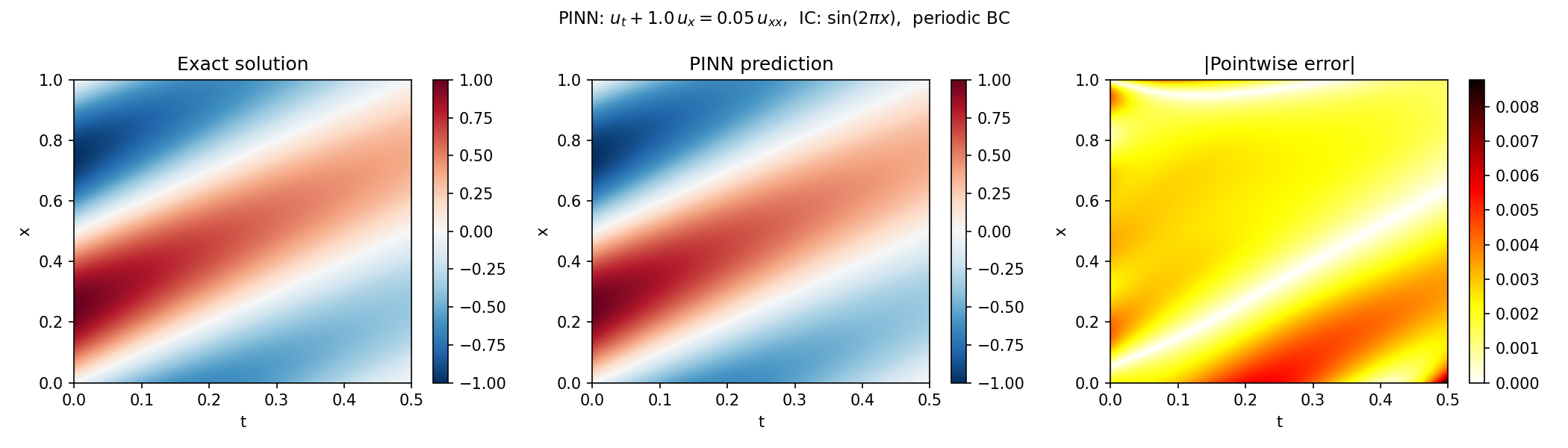
Approximating the solution of a linear PDE (1D advection-diffusion) with a neural network trained without any labelled interior data.
Approach
A PyTorch PINN enforces the PDE residual, initial condition, and periodic boundary conditions (both value and spatial-derivative periodicity) simultaneously via automatic differentiation, trained on collocation points with Adam. The original value-only formulation remains reproducible.
Result
A five-seed controlled study at the original 15,000-epoch budget compared the corrected loss with the historical value-only periodic loss. Enforcing derivative periodicity reduced the boundary derivative mismatch in every seed. This is a reduction in boundary mismatch, not in solution error: global L² accuracy did not improve reliably, and the corrected formulation showed a higher PDE residual, an unresolved optimisation and loss-balancing trade-off.
Limitations
One smooth, low-frequency test problem; loss weights were not tuned; five seeds; the primary comparison uses one training budget, with a second budget (30,000 epochs) run afterwards as a diagnostic. The figure shows the historical value-only formulation.