CFD · Finite elements
My contribution
I implemented a Taylor–Hood solver and evaluated geometry, mesh, time-step, and force-definition effects against cylinder-flow benchmarks.
Research implementation · validation limitations documented
Verified O(h³)/O(h²) velocity convergence; complete unsteady benchmark reproduction is not claimed.
Problem
Solving 2D incompressible viscous flow past a cylinder accurately enough to compare quantitatively with a published community benchmark, and separating the geometric, temporal, spatial and force-evaluation contributions to the remaining discrepancies, not just producing a qualitatively plausible flow.
Approach
Velocity-pressure formulation on Taylor–Hood P2/P1 elements (FEniCSx/PETSc), ruling out checkerboard pressure modes by construction; Crank–Nicolson time integration for the unsteady case. Degree-2 curved (isoparametric) cylinder geometry, checked after mesh import; four force definitions, including the variational reaction force; per-cycle extraction of the unsteady observables with a periodicity check.
Verification
A manufactured-solution study confirms the theoretical convergence rates: O(h³) velocity-L², O(h²) velocity-H¹ and pressure-L². Curved geometry reduces the cylinder-area error from −0.17% (inscribed polygon) to about 2×10⁻⁷, a statement about how well the circle is represented rather than about the order of the flow solution.
Key finding
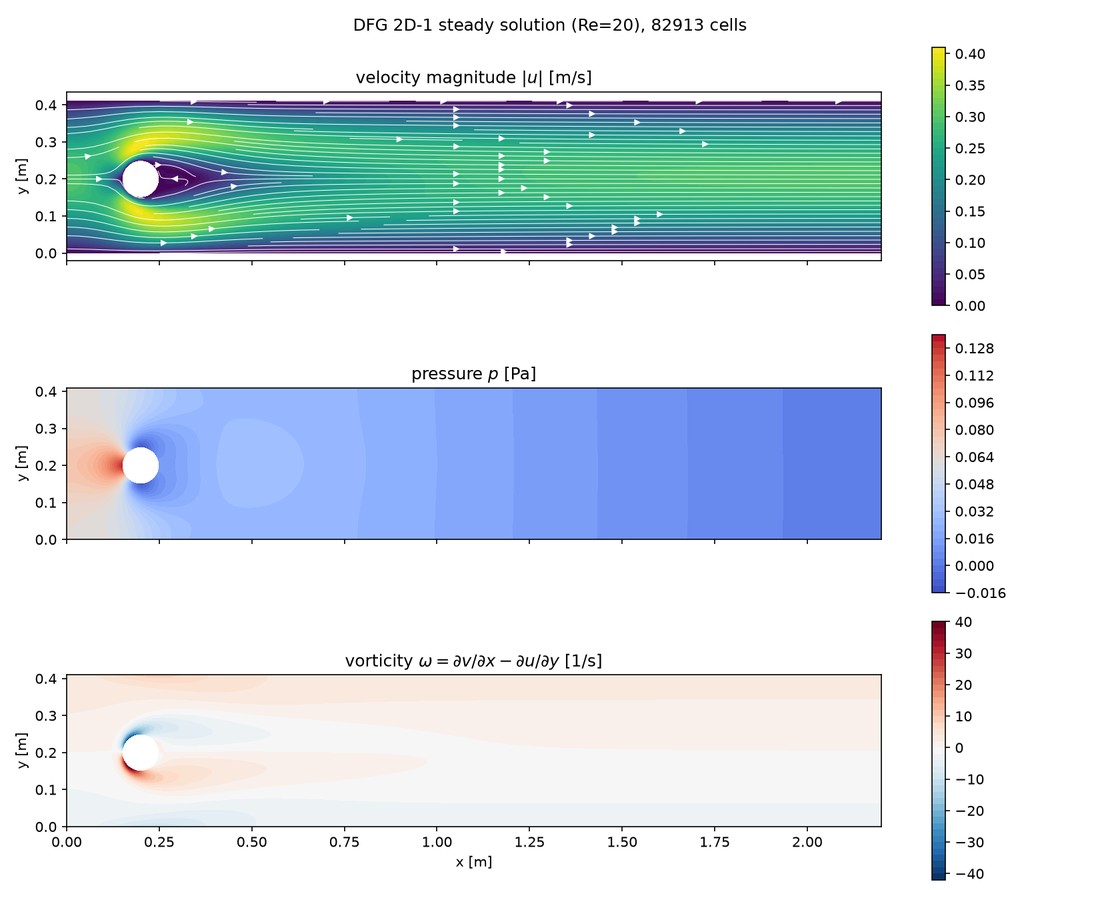
The finest steady DFG 2D-1 computation (curved geometry) closely matches the published FeatFlow spectral reference (cD = 5.57953, cL = 0.010619, ΔP = 0.11751); drag converges monotonically over the mesh ladder, lift does not.
In the unsteady 2D-2 case, a five-level study to 273k degrees of freedom combines degree-2 curved geometry, spatial and temporal refinement, audited force definitions and periodic-cycle extraction. The refined peak drag (3.226–3.228 across force definitions) and Strouhal number (0.3018) lie within their inherited benchmark ranges; the pressure difference is also within range but is not claimed as spatially converged. The refined peak lift is approximately 0.987 (0.9865–0.9879 across force definitions), slightly below the inherited 0.9900 lower bound while closely matching the published FeatFlow computation examined in the study (0.9866). Full 2D-2 reproduction is therefore not claimed.
Limitations
The 2D-2 runs end at t = 12 s rather than the benchmark's later 25–30 s window; the 1996 benchmark intervals were carried over from earlier project documentation and not independently re-verified, and the original timing convention for the pressure difference was not checked; the peak-lift value retains a small force-definition dependence (about 0.14%).