Inverse problems · Uncertainty
My contribution
I implemented adjoint-based inversion and pCN sampling, checking the solver, gradients, and sampler against independent references.
Research implementation · validation limitations documented
0.59% sampler verification error on a linear-Gaussian reference; full PDE posterior mixing remains limited.
Problem
Recovering a spatially varying log-permeability field in an elliptic Darcy-flow model from noisy, spatially local pressure observations, both as a point estimate and as a full posterior distribution.
Approach
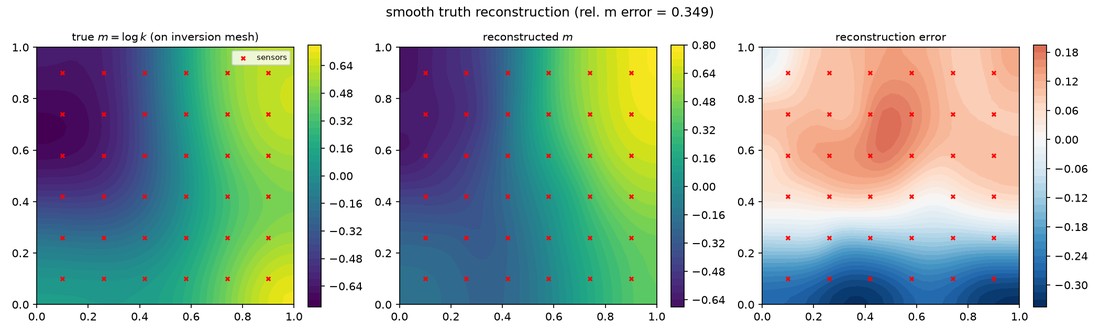
Adjoint gradients via UFL automatic differentiation, H¹/L² Tikhonov regularisation with discrepancy-principle selection, solved by L-BFGS-B. The Bayesian extension places a Karhunen–Loève-parameterised Gaussian prior over the field, sampled by preconditioned Crank–Nicolson (pCN) MCMC.
Verification
Forward solver verified by the method of manufactured solutions (inverse-crime avoided by using a different mesh/discretisation for data generation); adjoint gradient verified by a second-order Taylor-remainder test; the pCN sampler verified against an analytically tractable linear-Gaussian posterior.
Key finding
The H¹-seminorm regulariser reconstructs a smooth truth well but cannot recover sharp, localised structure regardless of regularisation strength: a regularisation-model mismatch. For the full PDE posterior, effective sample size is low in several Karhunen–Loève dimensions with strong autocorrelation, so MAP, not the posterior mean, is used as the primary trustworthy point estimate.
Limitations
The H¹-seminorm prior cannot represent sharp inclusions (relative error 0.849 for the structured truth at the selected strength, and 0.82 to 0.89 across all tested strengths, α = 0.01 to 30). For the PDE posterior, effective sample sizes per Karhunen–Loève dimension are 4.9 to 86.1 from 8,000 retained samples and split-chain means differ by up to 0.70 prior standard deviations, so the posterior mean is not treated as converged.