Dynamical systems · Uncertainty
My contribution
I implemented and independently checked an ensemble Kalman filter, then studied localisation, ensemble size, and filter failure.
Research implementation
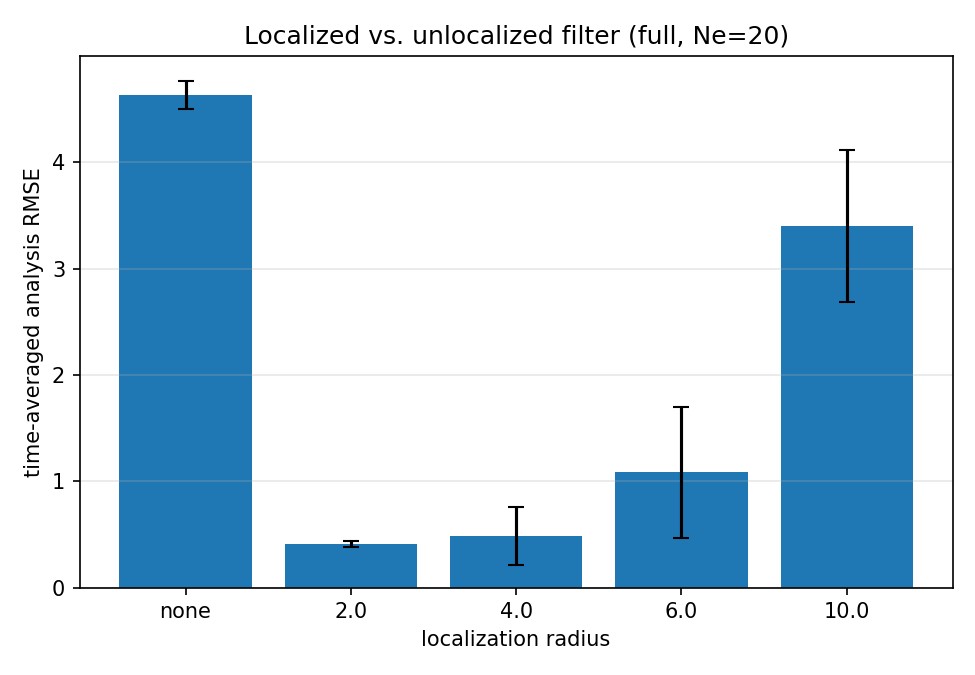
Localisation reduces RMSE from 4.63 (a diverged unlocalised filter) to 0.41, below the observation noise (10 seeds).
Problem
Estimating the state of a chaotic 40-dimensional dynamical system (Lorenz-96, K=40, F=8) from sparse, noisy observations, and characterising how ensemble size, localisation, and inflation govern filter performance and failure.
Approach
RK4 integration of the Lorenz-96 ODEs; Benettin two-trajectory renormalisation for the largest Lyapunov exponent; stochastic Ensemble Kalman Filter with perturbed observations; Gaspari–Cohn covariance localisation; multiplicative inflation.
Verification
Estimated largest Lyapunov exponent λ₁ ≈ 1.69, consistent with the literature range for K=40, F=8; the EnKF implementation verified against the exact Kalman filter on a linear-Gaussian problem with a known closed-form solution.
Key finding
With 20 ensemble members, Gaspari–Cohn localisation (radius 2) reduces the time-averaged analysis RMSE from 4.63 to 0.41 (10 seeds), below the observation-noise level of 1.0. The unlocalised filter it is compared with has effectively diverged (its RMSE is barely below the 4.93 of a free forecast, with severe ensemble under-dispersion), so the over-11× ratio measures recovery from filter divergence. Very small ensembles can settle into a stable but persistently wrong state.
Limitations
The localisation radius was chosen from the same 10 seeds that are reported (the next radius tested still gives a 9.5× reduction). Inflation alone is insufficient (best RMSE 3.16). Some observation-density and observation-frequency effects are non-monotonic and not explained. The model parameters are known; only the state is estimated.